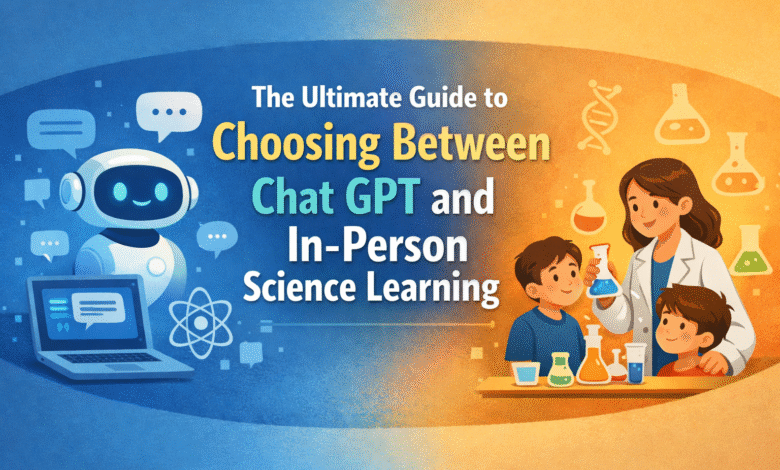
Science is one of the most interesting disciplines for students to engage in, yet it can also be demanding. Topics that can initially seem complex include forces and chemical processes. Compared to earlier times, students now have more possibilities for learning. The artificial intelligence programs are being used by many students in conjunction with educational settings to improve lecture understanding.
Consequently, the most crucial query is: Which is more effective?
Actually, each has advantages, and combining them might occasionally yield the finest outcomes.
Let’s examine both viewpoints
How to Understand
One AI tool that can help students understand difficult concepts is ChatGPT, which can react to questions rapidly.
Students commonly utilize it to:
- Inquire about subjects they don’t understand.
- Get straightforward explanations of difficult concepts
- Go over the material before the test.
- Deconstruct complex definitions
- Generate practice questions
When students are pursuing studies at home without a teacher nearby, this kind of online support is extremely beneficial. But if you are overburdened with college assignments or class tests, you can simply pay someone to do online course with MyAssignmentHelp so that you can concentrate on your exams at that time.
Advantages
- Immediate Assistance Anytime
One of its primary advantages is its constant accessibility. Students can ask questions at any time; they don’t have to be patient until the following class day. You can receive assistance right now if you have no idea about any topic at night.
- Basic Descriptions
Textbooks can utilize challenging terminology at times. it has the ability to simplify scientific concepts. This helps students understand basic ideas before moving to advanced details.
- Customized Pace of Learning
Teachers need to adjust the classroom pace to deal with students. With its help, students can go at their own individual speed. They can inquire about related subjects or have explanations repeated.
- Excellent for Editing
Before examination, students may request AI tools to create questions or provide a summary of the material. Revision consequently turns more participatory.
- Promotes Interest
Raising questions during lectures can make students seem uncomfortable. They can ask questions without feeling ashamed thanks to AI. This fosters desire and deep study.
Limitations
Even though it is quite useful but still cannot fully replace classroom learning.
- No Practical Tests
Science incorporates research; it’s not simply theory. Chemical processes can be read about, but it’s much easier to comprehend when you watch one occur in a lab.
- No Physical Demonstrations
Instructors can display trials and models in real time. This visual and physical learning is hard to replace with text explanations.
- Less Human Interaction
In the classroom, students raise additional queries and gain knowledge from their GENz friends. Real discussions cannot be completely replaced by AI.
- Self-Control Is Needed
Effective use of AI skills necessitates concentration. It’s simple to become sidetracked when you don’t have an instructor to guide you.
Comprehending In-Person Science
Learning science in an educational environment with a teacher and fellow students is known as in-person learning. This is the most conventional and widely used approach.
Students in classrooms:
- View in-person demonstrations
- Conduct laboratory experiments
- Pose straightforward questions to professors.
- Collaborate in teams
This method provides a complete learning environment. Chemistry is generally considered an ideal subject for in-person learning. When you receive the best and most accurate guidance from your teacher, you won’t need to ask, can I pay someone to take my online class for me? especially for subjects like chemistry and biology. Because with the right guidance, you’ll naturally develop an interest in the subject.
Advantages
- Practical Experiments
When students conduct their own experiments, chemistry becomes more understandable. Utilizing microscopes or combining chemicals may be useful in the retention of concepts.
- Direct Assistance for Teachers
Instructors can modify explanations when they see students’ confused expressions. They can provide illustrations, instances, or demos right away.
- Collaborative Education
Students can benefit from one another’s knowledge through group projects. Peer explanations enhance comprehension.
- Organized Education
Schedules and routines are provided by schools. This helps students in maintaining their discipline and going over every subject in detail.
- Interpersonal and Interaction Skills
Students who study in the classroom develop their listening comprehension and teamwork abilities.
Constraints
- Time Restriction
Class times are brief. Teachers might not have enough time to fully address every query.
- A Single Pace of Instruction
Students find it difficult to change the speed of a session if it seems too swift or too sluggish.
- Missed Instruction
Students who miss classes due to medical conditions or other factors may struggle to make up without further assistance.
Conditions That Affect Which Works Best
Some things affect the educational format preference:
- Age Group: While adults like the freedom of online learning, younger learners gain more from in-person class settings.
- Study Area: Students pursuing engineering and medical require labs and practical experience; they also choose in-person training.
- Location and Resources: For worldwide availability, learners from rural or isolated areas may mostly rely on virtual schooling.
- Learning Style: While cooperative students do well in school settings, independent students benefit online.
When Does Chat GPT Work Best?
It is most effective when students require:
- Brief justifications
- Explanation of assignments
- Additional practice questions
- Basic summaries
- Assistance with editing before exams
You can utilize it at any time, much like a study helper.
When Is In-Person Training Most Important?
Learning requires in-person attendance at classes:
- Laboratory tests
- Realistic abilities
- Intricate demonstrations
- Collaborative projects
- Discussion-based subjects
Science frequently calls for not just reading but also seeing and acting.
Why It’s the Best Option to Combine Both
Students who use both tools simultaneously learn the most.
For instance:
- Study a subject in class.
- Conduct experiments in the classroom
- Use a chatbot to go over things after returning home.
- Ask any learning tool to clarify any challenging sections.
- Come back to class prepared with questions.
Chat Understanding is strengthened in both ways by this cycle.
Hybrid Education: A Balance
Many companies will have implemented a hybrid approach, which blends the best aspects of both methods. Students, at times, participate in live labs and workshops alongside their webinars.
- Advantages include more convenience and organizational flexibility.
- For instance, universities increasingly have “hyflex” models, which let students join in person or virtually according to convenience and choice.
One approach that is thought to be resilient for addressing the gap between technologies and custom is hybrid learning.
Conclusion: Which Is Superior?
Both approaches work more successfully when combined rather than when used separately.
- ChatGPT is great for short answers and assistance.
- Experiments and demonstrations require face-to-face instruction.
Students who utilize AI tools wisely in conjunction with classroom instruction frequently gain a deeper understanding of science and boost their self-esteem.
The probable future of education involves a clever fusion of classroom instruction and internet-based learning.
FAQs
1.Can ChatGPT take the place of science professors entirely?
No, science professors cannot be entirely replaced by it. Science comprehension necessitates both justification and practical application.
2.Is it beneficial to learn complex scientific subjects?
It is an invaluable resource for studying complex scientific subjects, in fact. It has the ability to translate difficult concepts into simple terms.
3.How can students best integrate classroom instruction with AI?
The best approach is to study subjects in class first, after which utilize this at home for test preparation and clarification.
4.Why is it still vital to take science lessons in person?
In-person science lessons are valuable because they enable students to do experimentation and learn through group activities.
About The Author
Sophia is a biology specialist who enjoys creating scientific and medical topics easy for pupils to comprehend. They produce clear, practical guides to assist young students in selecting the best career route.